
Best Things To Do on Route 66 in Tulsa, OK
Welcome to the Capital of Route 66!
The Mother Road’s father, Cyrus Avery, was a Tulsan. Get your kicks and follow our picks of best attractions on Route 66 in and around Tulsa. Listed from east to west with a map at bottom.
Heading to Oklahoma City? We’ve got you covered on Route 66 in OKC too!
The Blue Whale
One of Route 66’s most photographed curiosities is the Blue Whale of Catoosa. You can walk into the whale’s happy mouth and get souvenirs at the gift shack. This attraction reopens on May 30, 2026. The Blue Whale’s creator built this for his wife’s anniversary gift in 1972. Find it in Catoosa, about 15 minutes/miles east of downtown Tulsa. The City of Catoosa now owns the whale and surrounding property to make improvements like walking trails.
If you’re hungry but tired of burgers and fried fare, try Elle’s Cafe (on Facebook) for Lao papaya salad, pho, Banh mi, noodle and rice dishes. It has some of the best Asian cuisine in the Tulsa area and is just a few minutes west of the whale along 66.
2600 U.S. Rte 66, Catoosa, OK
Desert Hills Motel

Built in 1953, this style of motor court was popular along Route 66. You probably don’t want to spend the night at what one traveler called the “worst motel in the world” on Tripadvisor, so get a photo with the neon sign at 5220 E 11th St and motor on, perhaps to nearby antique stores.
See recreated neon signs at the sign park (listed below) and at businesses between Lewis and Peoria avenues closer to downtown.
Tally’s Good Food Cafe

Enjoy breakfast all day at this comfort food cafe that began as a diner in the 40s and has been known as Tally’s since 1987. Large entrees include Fat Boy cheese burgers, chicken fried steak and chicken and waffles. Tally’s is famous for a cinnamon roll the size of a hubcap. Walk it off across Yale Avenue to see bubble letter murals of states along Route 66 and murals about Tulsa’s native and early history.
1102 S Yale Ave at 11th St | tallyscafe.com
Golden Driller

Tulsa’s most iconic symbol, the Golden Driller is a giant statue of an oil rig worker, or roughneck. The first driller was a gold tone statue for the 1953 International Petroleum Exposition, a world famous trade show when Tulsa was “Oil Capital of the World.” The temporary exhibit was so popular that a new one climbing a rig was shown at the 1959 show. A third and final driller for the 1966 show was built to last. His bones are steel rods said to withstand up to 200 mph winds. His skin is made of plaster and painted mustard yellow. One arm rests on a real oil derrick. At 76 feet, he’s one of the tallest free-standing statues in the world. Detour just south of Route 66 to find the Golden Driller at Expo Square. Learn about oil history on our tour with an oil baron’s tunnel.
4145 E 21st St at Pittsburgh Ave
Mother Road Market

Take your pick of burgers, sushi, tacos and more from a dozen local vendors at Tulsa’s only food hall. This is a great place for lunch on the road. Our top choice is the fried chicken sandwich at Chicken & the Wolf. Go easy on the hot sauce — even mild is darn spicy. And don’t pass up a scoop from Big Dipper Creamery on your way out!
Next door on the southwest corner of 11th Street & Lewis Ave are local souvenir shops, tourist information center, and Doctor Kustom — an authentic Brazilian restaurant with a picanha sandwich that sells out (Thursdays only).
1124 S Lewis Ave at 11th St | motherroadmarket.com
Land of the Giants: Rosie, Buck, Stella, Mack & Bob
Continuing west on 11th Street toward downtown, you’ll encounter a series of towering fiberglass statues now dubbed “Land of the Giants.” They include Rosie the Riveter, Buck Atom, Stella Atom, Meadow Gold Mack, and Cowboy Bob.
Rosie the Riveter, from the iconic “We Can Do It!” 1943 WWII poster, is modeled after Naomi Parker Fraley, who was born in Tulsa. She broadly symbolizes American feminism and more specifically the wartime contributions from women, who rolled up their sleeves as she did working on naval aircraft in California in the 40s.
Buck Atom's Cosmic Curios on 66 and Stella Atom

Two quirky monuments and souvenir shops embody Tulsa’s Route 66 revival.
Meet space cowboy Buck Atom, a 21-foot fiberglass statue that’s sure to get your attention. This “muffler man” brings nostalgia for these roadside giants along old Route 66. Instead of a car part, Buck holds a gleaming rocket ship. He stands outside a 1950s gas station that’s now a Route 66 souvenir shop owned by retail entrepreneur Mary Beth Babcock whose father inspired this statue.
Joining Buck is Stella Atom, a cosmic cowgirl designed after Babcock’s mother who stands 19’ tall with a Route 66 shield for a belt buckle. Buck and Stella are essential photo ops.
Next door, Decopolis 66 has Tulsa souvenirs, gifts, dinosaurs, postcards, and Art Deco mini-museum.
Buck’s on 66: 1347 E 11th St | buckatomson66.com
Decopolis 66: 1401 E 11th St | decopolis.net
Meadow Gold Sign

This restored neon sign sits atop a brick pavilion with plaques about the sign’s history. From the 1930s to 70s, the Meadow Gold sign advertised smooth dairy products on a building on 11th Street. When that building was torn down in 2004, the sign was saved and stored until being relit on its new perch in 2009. Don’t miss the adjacent You Said We Couldn’t Do It mural about the bridge that saved Tulsa.
1324 E 11 St at Peoria Ave
Meadow Gold Mack & Cowboy Bob
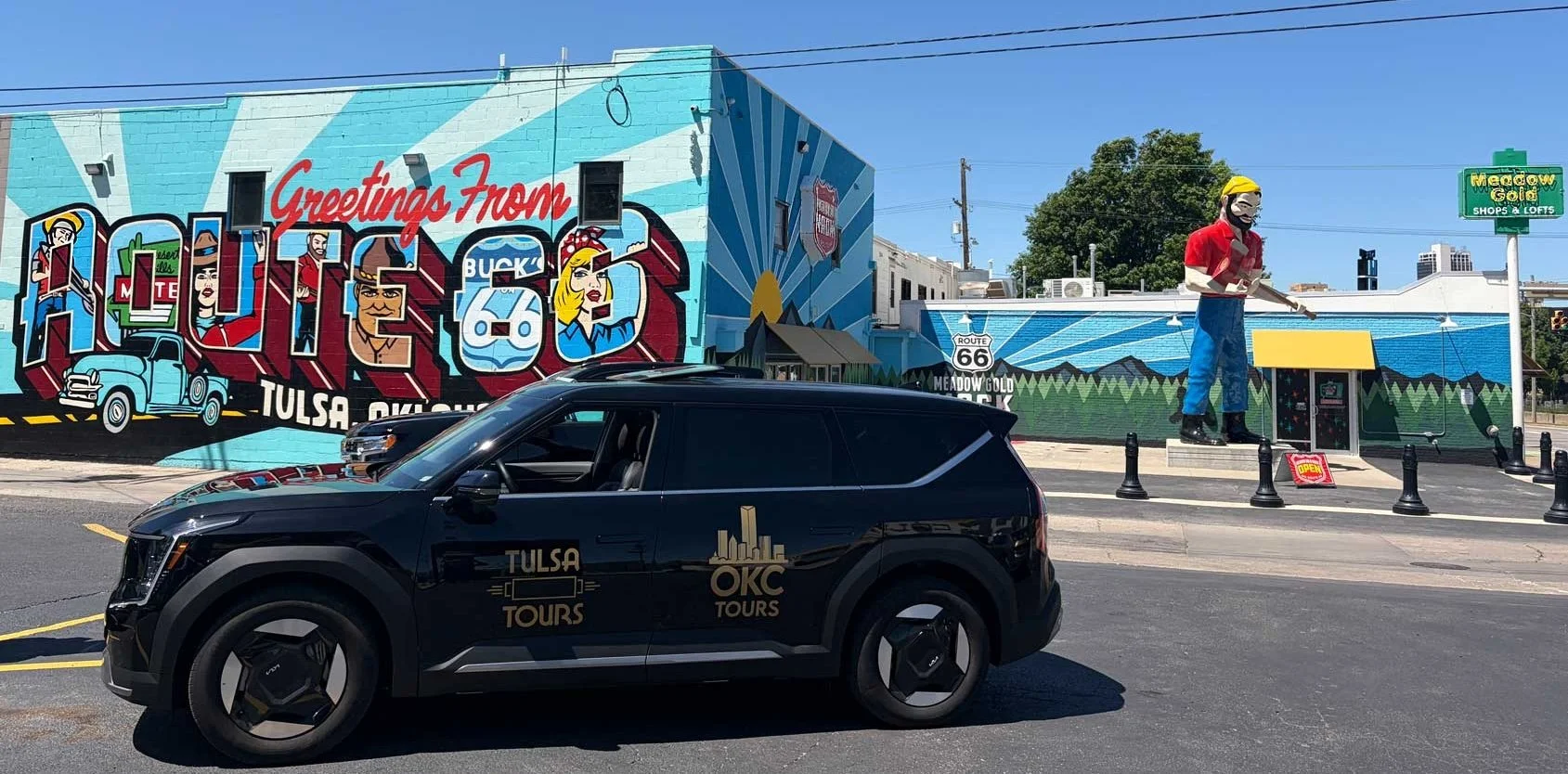
Just before busy Peoria Avenue are the newest 20’ muffler men: Meadow Gold Mack the Friendly Lumberjack once stood outside a lumber shop in Illinois while Cowboy Bob the Honky Tonk King is styled after Bob Wills, the King of Western Swing. Mack stands outside his Route 66 Outpost filled with souvenirs a new postcard greetings mural that features the other nearby giants.
1306 E 11 St at Peoria Ave | meadowgoldmack.com
The Blue Dome

This former gas station was a luxury pit stop in 1924 when it opened on 2nd Street along the original alignment of Route 66 in Tulsa. Motorists enjoyed 24-hour service with new-at-the-time amenities like hot water, car wash and pressurized air to keep those tires pumped. The White Star Gulf Oil Station was also listed in the Green Book, allowing black drivers to get service, too. Built of blond bricks in an Art Deco style, the building is closed except for special events. However, check out Blue Dome District bars, restaurants, bowling and murals.
313 E 2nd St
Cyrus Avery Centennial Plaza and 11th Street Bridge


The Mother Road runs through Tulsa because of this bridge. Cyrus Avery, father of Route 66, convinced the highway commission to use this 11th Street bridge — now blocked off in disrepair — rather than build a new one in a different town. Opened in 1917, this bridge was the only steel-reinforced concrete bridge over the Arkansas River at the time. In the plaza, flags from Route 66 states flutter in the breeze. Life-size bronze sculptures, called “East Meets West,” show the Avery family in their Model T surprising a horse-drawn oil field cart. Shifts in culture and physical geography support this river being a true diving line between America’s East and West.
Southwest Blvd at Riverside Dr
Musical Road in Tulsa
Drive the speed limit and your tires will hum the tune “This Land is Your Land” by Woody Guthrie. You’ll hit these notes at 35 mph eastbound on the Southwest Boulevard 11th Street Bridge heading back to downtown. The rumble strips are in the left lane. After Albuquerque, this is the second musical road installed on Route 66. Was it worth the cost of $110,000? You be the judge.
Neon Sign Park

Drive, bike or walk across the new Cyrus Avery Memorial Bridge to West Tulsa and relive the neon glory of Route 66 motel signs. These are replicas of three bygone motels: Oil Capital Motel, Tulsa Auto Court and Will Rogers Motor Court. There is no parking lot on this side of the street.
Southwest Blvd at River Parks West Trail
Route 66 Historical Village

On your way west, explore Tulsa’s oil capital origins. An oil derrick soars 194 feet above a Frisco Railway steam engine from 1940, lounge car, oil tanker from 1917, and caboose from the 30s. The derrick marks the spot of the area’s first oil strike in 1901. Although output was relatively small, it attracted lots of attention as roughnecks and speculators converged on Indian Territory to get rich. The Oklahoma oil rush was on, and Tulsa would soon become the Oil Capital of the World. The information center is a recreated 1920s Phillips 66 station that looks like a cottage. Maps, coffee and restrooms are inside.
3770 Southwest Blvd, Tulsa | facebook.com/Route66Village
Route 66 winds west through Sapulpa, Bristow, Stroud, Chandler, Wellston, Arcadia, and OKC. Here’s a list of things to do on Route 66 in Oklahoma City.